
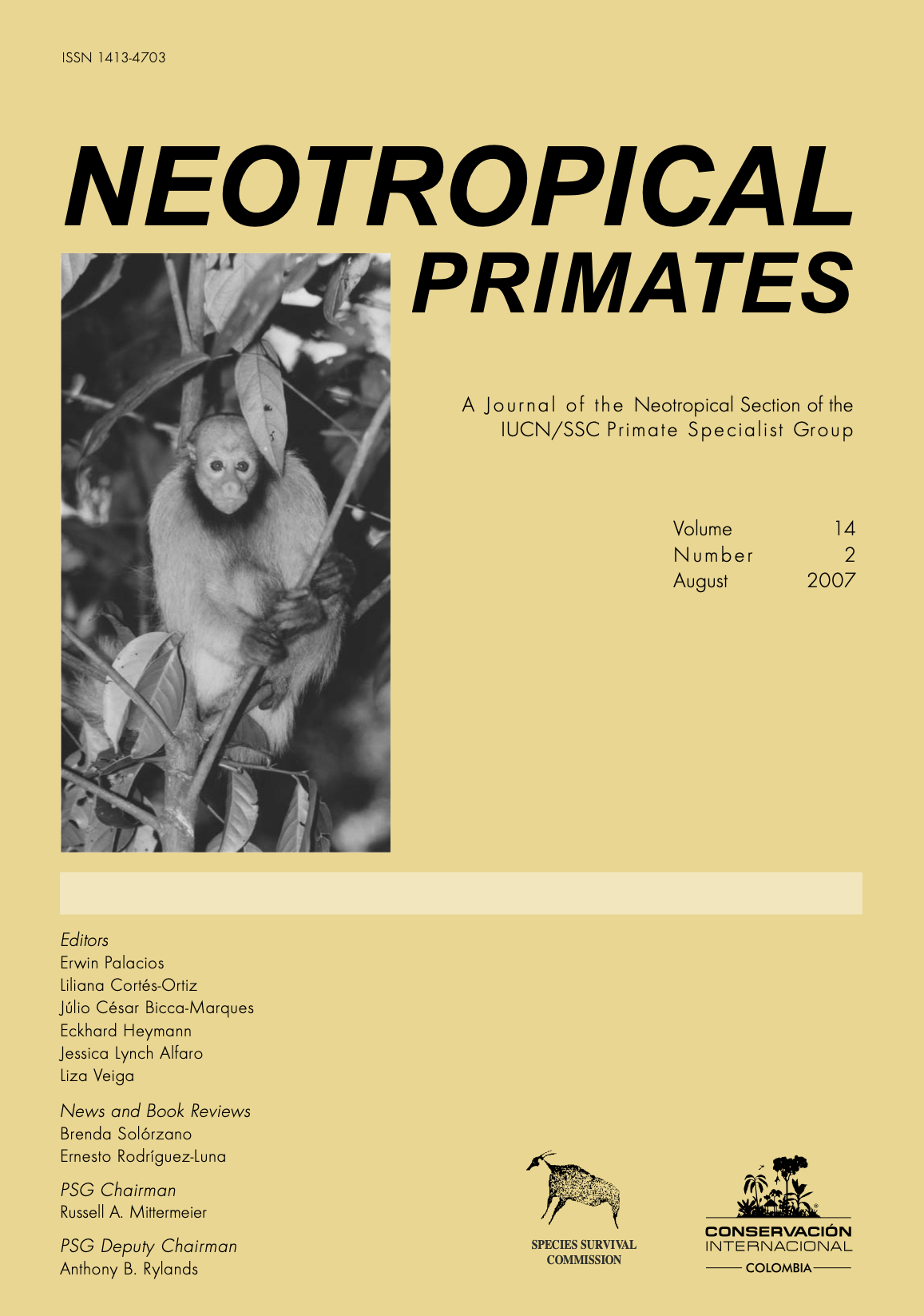
Resource use and seed dispersal by red howler monkeys (Alouatta seniculus) in a Colombian Andean forest
DOI:
https://doi.org/10.1896/044.014.0202Palavras-chave:
Andes, Colombia, red howler monkey, frugivory, folivory, montane forest, cloud forest, seed dispersal, habitat restorationResumo
As part of a study of responses by red howler monkeys (Alouatta seniculus) to forest fragmentation, we studied red howlers in an extensive forest including a habitat mosaic of old-growth forest, secondary forest of different ages, and non-commercial monospecific plantations of exotic Chinese ash (Fraxinus chinensis) and pines, to produce baseline information on resource use and their role as seed dispersers. We followed three troops for six months, encompassing a dry and a wet season; in total, they fed on 48 species of trees, including fruits, leaves and flowers, but each group relied on a limited set of species available within its home range, particularly in the Moraceae and Cecropiaceae. This contrasts with lowland forest, where howlers feed on a larger variety of species. We observed no season of generalized fruit scarcity, as is the case in the lowlands. However, localized fruit scarcities in howler home ranges occurred. Howlers fed on relatively small quantities of leaves when fruit was available, and became primarily folivorous when fruit was unavailable. Howlers transported a mean of 2.3 species of seeds per fecal sample, to a mean distance of 116 m from the parent tree. More importantly, howlers are transporting seeds to ash and pine plantations, helping to enrich these habitats.
Downloads
Downloads
Publicado
Edição
Seção
Licença

Este trabalho está licenciado sob uma licença Creative Commons Attribution-NonCommercial-ShareAlike 4.0 International License.