
The challenges of primate research and conservation in Paraguay
DOI:
https://doi.org/10.62015/np.2022.v28.222Palabras clave:
América Latina, Desarrollo científico, Desarrollo comunitario, primatología, retosResumen
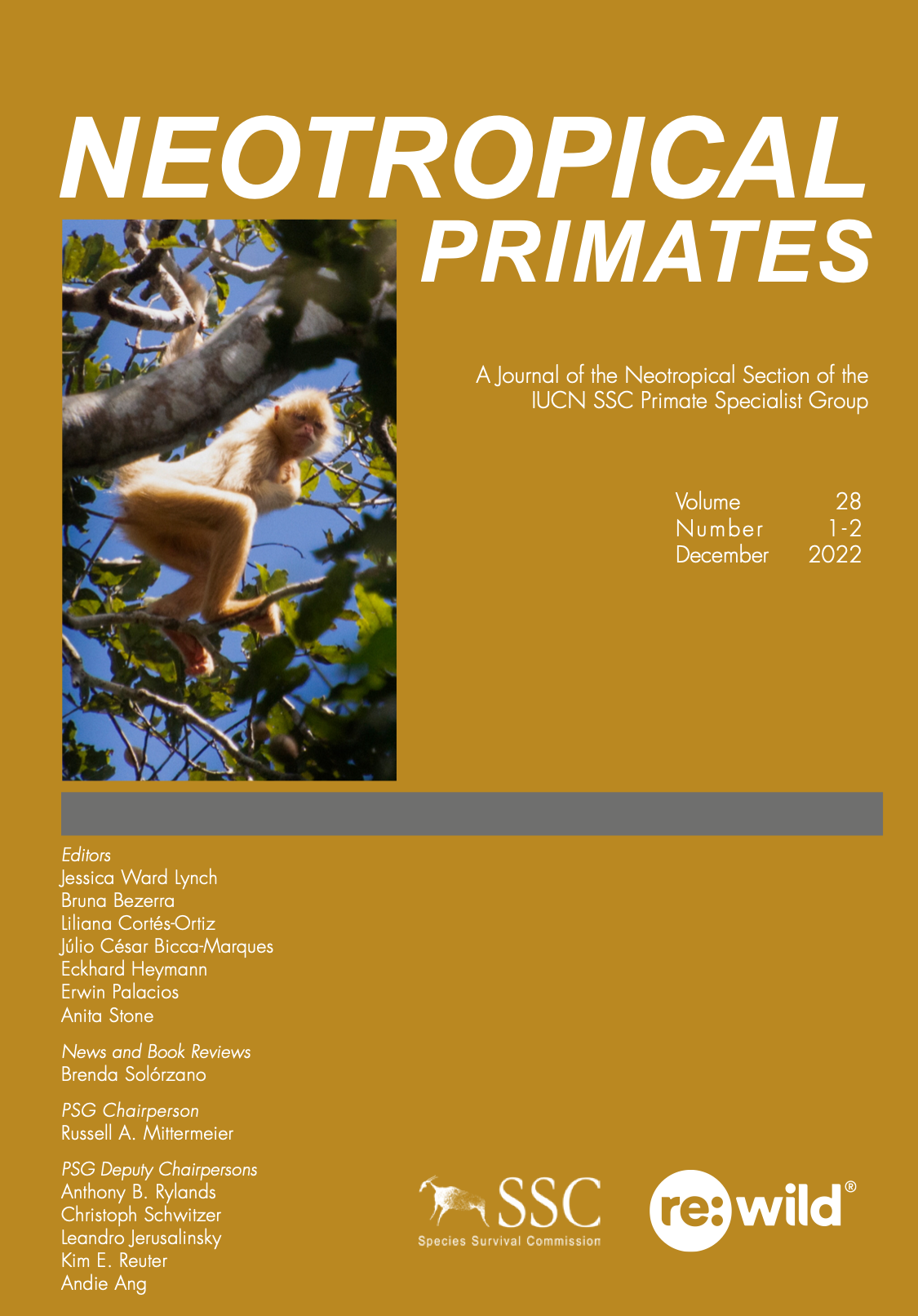
La fauna de primates de Paraguay consta de solo cinco especies (Sapajus cay, Alouatta caraya, Aotus azarae, Plecturocebus pallescens y Mico melanurus) y su estudio ha sido ignorada en gran medida por la comunidad primatológica internacional. No obstante, Paraguay tiene actualmente la segunda tasa de deforestación más alta de América Latina y las amenazas que enfrentan los primates paraguayos son tan graves como en cualquier otro lugar del continente. La conservación de primates en Paraguay se complica por la ausencia total de una comunidad de investigación primatológica local y el país carece de la base sólida de investigación biológica requerida para el desarrollo de estrategias de gestión efectivos. En el país existe solo un título de grado universitario en biología (con la Universidad Nacional de Asunción), y las oportunidades de educación de posgrado en ciencias biológicas requieren estudiar en el extranjero, mientras que el número limitado de oportunidades de carrera al graduarse significa que quienes reciben dicha formación con frecuencia prefieren seguir sus carreras en otros lugares en lugar de regresar al país para ejercer. Actualmente no hay cursos de educación superior en primatología disponibles en Paraguay. Fundación Para La Tierra (PLT) es una ONG de educación y conservación paraguaya (80086144-2), fundada en 2010. PLT se enfoca en la conservación de los hábitats naturales de Paraguay a través de la investigación científica, la participación comunitaria y la educación, e implementa los únicos trabajos de investigación de campo en primatología a largo plazo en el país: el “Proyecto Capuchino Encapuchado” que busca conservar el Sapajus cay en lo poco que queda del Bosque Atlántico del Alto Paraná y el “Proyecto Mono Aullador Urbano” que investiga la ecología del comportamiento de las poblaciones de Alouatta caraya que habitan en la ciudad de Pilar. Los proyectos de primates de PLT adoptan un enfoque multifacético: investigación científica a largo plazo, capacitación y apoyo a la población local interesada en los primates, supervisión de estudiantes internacionales y educación ambiental en las escuelas. En este artículo discutiremos los desafíos enfrentados en desarrollar un proyecto de esta clase en Paraguay y una visión para el futuro de la primatología en el país.
Descargas
Referencias
ABC Color. 2020a. Estudiantes de la UNA se manifestarán pidiendo arancel cero. https://www.abc.com.py/tv/abc-noticias/2020/07/07/estudiantes-de-la-una-se-manifestaran-pidiendo-arancel-cero/. Accessed on 02/01/2021.
ABC Color. 2020b. Estudiantes universitarios queman cubiertas en reclamo de arancel cero. https://www.abc.com.py/nacionales/2020/08/12/estudiantes-universitarios-queman-cubiertas-en-reclamo-de-arancel-cero/. Accessed on 02/01/2021.
ABC Color. 2020c. Estudiantes universitarios se movili- zarán por "arancel cero". https://www.abc.com.py/nacionales/2020/08/10/estudiantes-universitarios-se-movilizaran-por-arancel-cero/. Accessed on 02/01/2021.
Alesci, M., Smith, R. L., Santacruz Ayala, J. D. and Camperio Ciani, A. 2022. Attitudes towards urban black and gold howler monkeys (Alouatta caraya) in the city of Pilar, Ñeembucú, southwest Paraguay. Primates 63: 161–171.
Blair, M. E. 2019. Toward more equitable and inclusive spaces for primatology and primate conservation. Int. J. Primatol. 40: 462–464.
Cartes, J. L., Thompson, J. and Yanosky, A. 2015. El Chaco paraguayo como uno de los últimos refugios para los mamíferos amenazados del Cono Sur. Paraquaria Nat. 3(2): 37–47.
Cartes, J. L., del Castillo, H., Kowalewski, M. and Thompson, J. J. Velilla, M. 2017. Primates: los monos. In: Libro Rojo de Mamíferos del Paraguay, S. Saldívar, V. Rojas and D. Giménez (eds.), pp.55–60. Asociación Paraguaya de Mastozoología y Secretaría del Ambiente. Asun- ción, Paraguay.
Cartes, J. L., Velilla, M., González-Brítez, N. and Thompson, J. J. 2018. Estado de Conservación de los Primates en Paraguay. In: La Primatología en Latinoamérica 2. Tomo 2, B. Urbani, M. Kosalewski, R. G. T. Cunha, S. de la Torre and L. Cortés-Ortiz (eds.), pp.583–596. Edi- ciones IVIC, Caracas, Venezuela.
CONACyT. 2020a. https://www.conacyt.gov.py/pronii. Accessed 14th November 2020.
CONACyT. 2020b. https://www.conacyt.gov.py/sites/default/files/upload_editores/u274/criterios_agrarias_1.pdf. Accessed 14th November 2020.
Da Ponte, E., Kuenzer, C., Parker, A., Rodas, O., Oppelt, N. and Fleckenstein, M. 2017a. Forest cover loss in Paraguay and perception of ecosystem services: a case study of the Upper Parana Forest. Ecosystem Services 24: 200–212.
Da Ponte, E., Roch, M., Leinenkugel, P., Dech, S. and Kuenzer, C. 2017b. Paraguay’s Atlantic Forest cover loss—satellite-based change detection and fragmentation analysis between 2003 and 2013. Applied Geography 79: 37–49.
Da Ponte, E., Fleckenstein, M., Oppelt, N., Huth, J. and Kuenzer, C. 2018. Forest Cover loss in Paraguay: Earth Observation Analysis for Deforestation Policies. EAR- SeL Symposium: Chania, Crete, Greece.
de Vos, A. 2020. The problem of “colonial science.” Scientific American 1–10. https://www.scientificamerican.com/article/the-problem-of-colonial-science/.
Duffy, X., Wellian, J. and Smith, R. L. 2022. Use of space by black-and-gold howler monkeys (Alouatta ca- raya) in an urban environment in Paraguay. Urban Ecosystems 25: 1777–1786. https://doi.org/10.1007/s11252-022-01262-3.
FACEN 2020a. https://www.facen.una.py/es/licenciatura-en-tecnologia-de-produccion/. Accessed on 9th De- cember 2020.
FACEN 2020b. Resolución-N°-0272-2020. https://www.facen.una.py/es/resoluciones-nro-272-273-y-274/. Accessed on 9th December 2020.
Gokken, B. 2018. Recovering conservationist: Q & A with orangutan ecologist June Mary Rubis. Monga- bay. https://news.mongabay.com/2018/08/recovering-conservationist-qa-with-orangutan-ecologist-june-mary-rubis/. Accessed on 1st August 2022.
MADEs. 2020. Informe Mayo 2002—Reserva Para Parque Nacional San Rafael. Dirección de Geomatica.
Mecca, B. 2020. When your country is a case study: being an Indonesian environmentalist at Yale. Correspondents of the World. Accessed 1st August 2022.
Nkomo, M. N. 2020. The Achilles heel of conservation. iLizwe 1–11. https://ilizwi.co.za/the-achilles-heel-of-conservation/.
Rengger, J. R. 1830. Naturgeschichte der Saeugethiere von Paraguay. Schweighauserschen Buchhandlung, Basel, Switzerland.
Rímoli, J., Smith, R. L., Ludwig, G., Martinez, M., Kowalewski, M., Melo, R. and Lynch, W. 2022. Sapajus cay. The IUCN Red List of Threatened Species 2022: e.T136366A215548623. https://www.iucnredlist.org/species/136366/222944655. Accessed on 31st July 2022.
Rodrigues, M. 2021. SpiderMonkeyTales. http://spidermonkeytales.blogspot.com/2020/06/decolonizeprimatology-reading-list.html. Accessed on 1st August 2022.
Rodrigues, M. A., Kiiza, V., McLennan, M. R., Mendes S. L. and Strier, K. B. 2022. Narratives of positionality in primatology: foreign/range–country collaborator perspectives from Africa and South America. Int. J. Primatol. 43: 1133–158. https://doi.org/10.1007/s10764-022-00311-0.
Smith, R. L. 2017. Preliminary observations of complex object manipulation in a wild population of Sapajus cay Illiger 1815 (Primates: Cebidae) in a fragment of upper Paraná Atlantic Forest, Rancho Laguna Blanca, eastern Paraguay. Acta Ethologica 20: 75–80.
Smith, R. L. and Payne, C. 2017. Consumption of the bark of Albizia niopoides (Mimosaceae) by Sapajus cay Illiger, 1815 (Cebidae: Primates) in the Atlantic Forest fragment of Rancho Laguna Blanca in Eastern Paraguay. Mammalogy Notes 4(1): 17–20.
Smith, R. L. 2017. An observation of an unusual human-directed threat display by Sapajus cay Illiger, 1815 (Cebidae: Primates) in a fragment of Upper Paraná Atlantic Forest, eastern Paraguay. Mammalogy Notes 4(1): 15–16.
Smith, R. L., Hayes, S. E., Smith, P. and Dickens, J. K. 2018. Sleeping site preferences in Sapajus cay Illiger 1815 (Primates: Cebidae) in a disturbed fragment of upper Paraná Atlantic Forest fragment, Rancho Laguna Blanca, eastern Paraguay. Primates 59(1): 79–88.
Smith, R. L., Briggs, E. and Smith, P. 2020. Unusual behavioural responses of the South American coati Nasua nasua (Carnivora: Procyonidae) to hooded capuchins Sapajus cay (Primates: Cebidae) in the Paraguayan upper Paraná Atlantic Forest. Neotrop. Primates 26(3): 23–29.
Smith, R. L. 2021. The Ecology and Conservation of the Hooded Capuchin (Sapajus cay) in the Paraguayan Upper Paraná Atlantic Forest. University of Aberdeen. Ph.D. Thesis.
Smith, P., Rios, S. and Smith, R. L. 2021. Paraguayan primatology: past, present and future. Primate Conservation 35: 1–22.
Smith, R. L., Blood, R. and Smith, P. 2020. Observations of facial malformations, including cleft lip and palate, in wild primates in Paraguay. Journal of Medical Primatology 50(3): 193–196.
Smith, R. L., Rebergen, K., Payne, C., Megaponas, E. and Lusseau, D. 2022. Dietary plasticity of an umbrella species (Sapajus cay) in a Biodiversity Hotspot: applying ecological traits to habitat conservation in the upper Paraná Atlantic Forest. Folia Primatol. 93(1): 53–68.
Smith, R. L. and Lusseau, D. 2022a. Modelling habitat suitability for a potential flagship species, the hooded capuchin, of the Paraguayan Upper Paraná Atlantic Forest. Ecological Solutions and Evidence 3(3): e12146.
Smith, R. L and Lusseau, D. 2022b. The hooded capuchin monkey is Vulnerable in Paraguay and at least Near Threatened globally according to Red List Criteria. Poster Presentation. Primate Society of Great Britain Winter Conference 2022, Twycross Zoo, England.
Waters, S., El Harrad, A., Bell, S. and Setchell, J, M. 2021. Decolonizing primate conservation practice: a case study from North Morocco. Int. J. Primatol. 43: 1046– 1066. https://doi.org/10.1007/s10764-021-00228-0.
Wellian, J. and Smith, R. L. 2022. Risk awareness of black- &-gold howler monkeys (Alouatta caraya) living in an urban environment in south-west Paraguay. Journal of Urban Ecology 7(1): 1–8. https://doi.org/10.1093/jue/juab010.
Soto, C., Cabello, C., Scribano, R., Garicoche and J., Pec- koltz, F. 2015. Riesgo de degradación en el Chaco Paraguayo. Paraquaria Nat. 3(2): 48–52.
Stallings, J. R. and Mittermeier, R. A. 1983. The black-tailed marmoset Callithrix argentata melanura recorded from Paraguay. American Journal of Primatology 4: 159–163.
Stallings, J. R. 1984. Status and conservation of Paraguayan primates. MA thesis, University of Florida, Gainesville, USA.
Stallings, J. R. 1985. Distribution and status of primates in Paraguay. Primate Conservation 6: 51–58.
Stallings, J. R., L. West, W. Hahn and I. M. Gamarra. 1989. Primates and their relation to habitat in the Paraguayan Chaco. In: Advances in Neotropical Mammalogy, J. F. Eisenberg and K. H. Redford (eds.), pp.425–442. Sandhill Crane Press, Gainesville, USA.
World Politics Review. 2018. Can Paraguay’s dysfunctional education system be reformed? https://www.worldpoliticsreview.com/can-paraguays-dysfunctional-education-system-be-reformed/.
Wright, P. C. 1994. The behavior and ecology of the owl monkey. In: Aotus: the Owl Monkey, J. F. Baer, R. E. We- ller and I. Kakoma (eds.), pp.97–112. Academic Press, San Diego, USA.
Publicado
Número
Sección
Licencia

Esta obra está bajo una licencia internacional Creative Commons Atribución-NoComercial-CompartirIgual 4.0.