
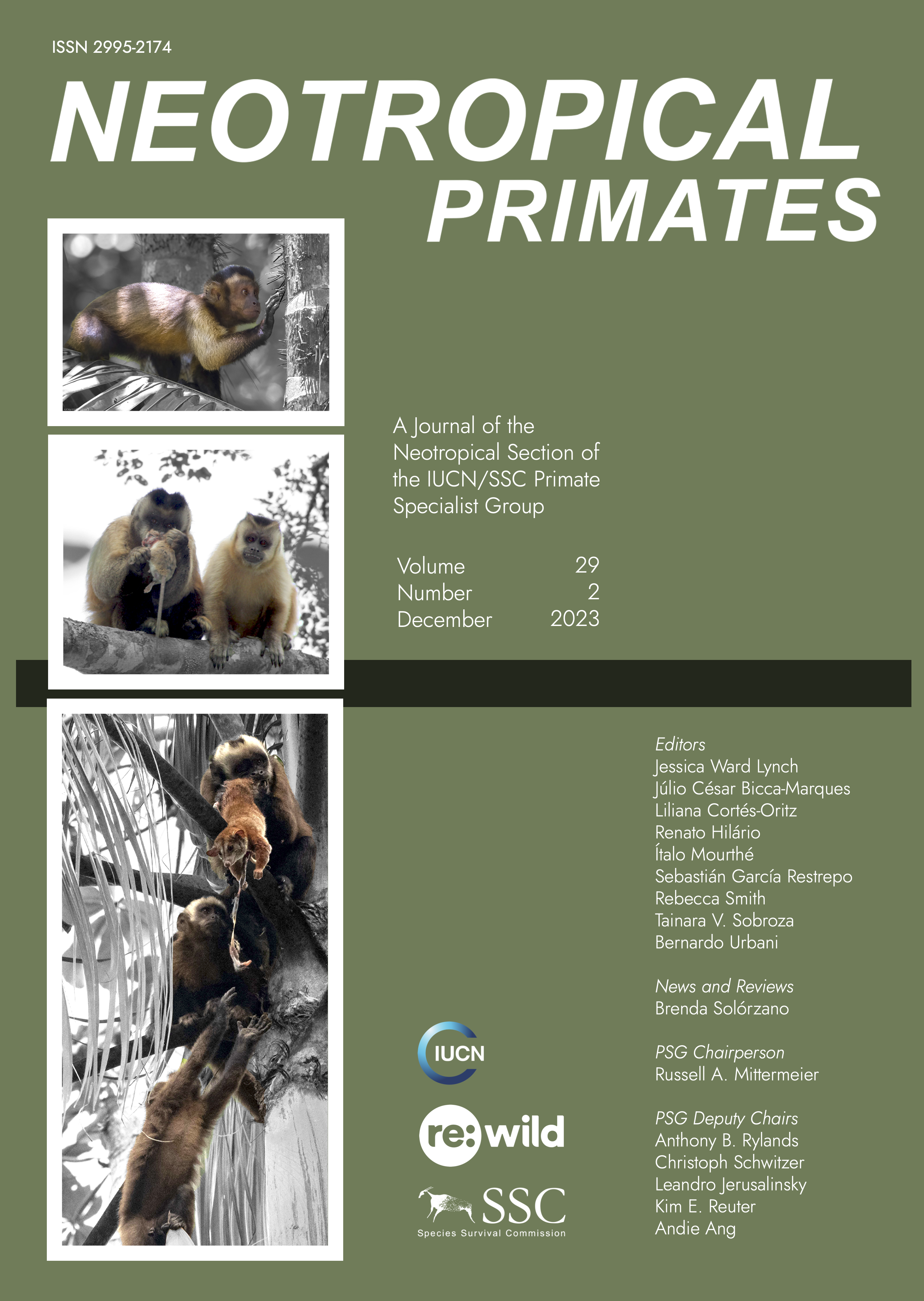
Predation on two brown-eared woolly opossums (Caluromys lanatus) by a group of large-headed capuchin monkeys (Sapajus macrocephalus) and notes on their hierarchical feeding behaviour
DOI:
https://doi.org/10.62015/np.2023.v29.819Palabras clave:
Dieta, depredación oportunista, primates neotropicales, Amazonía peruana, Reserva de Biósfera del ManuResumen
El mono capuchino de cabeza grande (Sapajus macrocephalus) es un omnívoro generalista conocido por su dieta flexible y estrategias de alimentación oportunista. En septiembre del 2022, en la Estación Biológica Manu Learning Centre al sureste de Perú, se observó un grupo de siete monos depredando a dos zarigüeyas lanudas de orejas marrones (Caluromys lanatus). La alimentación siguió un orden jerárquico, con el macho alfa y una hembra con un infante alimentándose primero, seguidos por un juvenil. No hubo comportamiento agresivo hacia los juveniles, lo que sugiere que los adultos pueden facilitar su alimentación. Esta observación agrega un nuevo ítem a la dieta de los capuchinos y resalta sus diversos hábitos alimenticios.
Descargas
Referencias
Boubli, J. P., Stevenson, P. R., Palacios, E., de la Torre, S., Ravetta, A. L., Messias, M. R., Carvalho, A. S. and Mittermeier, R. A. 2021. Sapajus apella. The IUCN Red List of Threatened Species 2021: e.T172351505A192594550. Accessed on 1 February 2023. https://www.iucnredlist.org/species/172351505/192594550
Cáceres, N. C. and Carmignotto, A. P. 2006. Caluromys lanatus. Mamm. Species 803: 1–6. https://doi.org/10.1644/803.1
Carretero-Pinzón, X., Defler, T. R. and Ferrari, S. F. 2008. Observation of black-capped capuchins (Cebus apella) feeding on an owl monkey (Aotus brumbacki) in the Colombian Llanos. Neotrop. Primates 15: 62–63. https://doi.org/10.1896/044.015.0210
Coelho, C. G., Falótico, T., Izar, P., Mannu, M., Resende, B. D., Siqueira, J. O. and Ottoni, E. B. 2015. Social learning strategies for nut-cracking by tufted capuchin monkeys (Sapajus spp.). Anim. Cogn. 18: 911–919. https://doi.org/10.1007/s10071-015-0861-5
di Bitetti, M. S. and Janson, C. H. 2001. Social foraging and the finder’s share in capuchin monkeys, Cebus apella. Anim. Behav. 62: 47–56. https://doi.org/10.1006/anbe.2000.1730
Emmons, L. H. and Feer, F. 1997. Neotropical rainforest mammals: A field guide. The University of Chicago Press, Chicago.
Fedigan, L. M. 1990. Vertebrate predation in Cebus capucinus: meat eating in a neotropical monkey. Folia Primatol. 54: 196–205. https://doi.org/10.1159/000156444
Ferreira, R., Resende, B. D., Mannu, M., Ottoni, E., B. and Izar, P. 2002. Bird predation and prey-transfer in brown capuchin monkeys (Cebus apella). Neotrop. Primates 10: 84–89. https://doi.org/10.62015/np.2002.v10.510
Gómez-Posada, C. 2012. Dieta y comportamiento alimentario de un grupo de mico maicero Cebus apella de acuerdo a la variación en la oferta de frutos y artrópodos, en la Amazonía colombiana. Acta Amaz. 42: 363–372. https://doi.org/10.1590/S0044-59672012000300008
Izawa, K. 1978. Frog-eating behavior of wild black-capped capuchin (Cebus apella). Primates 19: 633–642. https://doi.org/10.1007/BF02373631
Izawa, K. 1980. Social behavior of the wild black-capped capuchin (Cebus apella). Primates 21: 443–467. https://doi.org/10.1007/BF02373834
Janson, C. 1985. Aggressive competition and individual food consumption in wild brown capuchin monkeys (Cebus apella). Behav. Ecol. Sociobiol. 18: 125–138.
Janson C. and van Schaik C. 1993. Ecological risk aversion in juvenile primates: slow and steady wins the race. In: Juvenile primates: Life history, development, and behavior, M. E. Pereira and L. A. Fairbanks (eds). Oxford University Press, Oxford.
King, G. E. and Steklis, H. D. 1984. New evidence for the craniocervical killing bite in primates. J. Hum. Evol. 13: 469–481. https://doi.org/10.1016/S0047-2484(84)80001-9
Kurland, J. A. 1977. Contributions to primatology. Volume 12: Kin Selection in the Japanese Monkey. Karger, Basel.
Lambert, T. D., Malcolm, J. R. and Zimmerman, B. L. 2005. Variation in small mammal species richness by trap height and trap type in southeastern
Amazonia. J. Mammal. 86: 982–990. https://doi.org/10.1644/1545-1542(2005)86[982:VISMSR]2.0.CO;2
Lee, A. and Huang, M. 2021. Oropendola nest predation and rodent consumption by the black-capped capuchin (Sapajus apella) in the Manu Biosphere Reserve, Peru. Neotrop. Primates 27: 30–32. https://doi.org/10.62015/np.2021.v27.63
Milano, M. Z. and Monteiro-Filho, E. L. A. 2009. Predation on small mammals by capuchin monkeys, Cebus cay. Neotrop. Primates 16: 78–80. https://doi.org/10.1896/044.016.0210
Mittermeier, R. A., Rylands, A. B. and Wilson, D. E. 2013. Handbook of the mammals of the world. Volume 3: Primates. Lynx Edicions, Barcelona.
Palmeira, F. B. L. and Pianca, C. C. 2012. Predation attempt on a roadkilled brown-eared woolly opossum (Caluromys lanatus) by a black-horned capuchin (Sapajus nigritus). Neotrop. Primates 19: 36–38. https://doi.org/10.1896/044.019.0107
Perry, S. and Rose, L. 1994. Begging and transfer for coati meat by white-faced capuchin monkeys, Cebus capucinus. Primates 35: 409–415. https://doi.org/10.1007/BF02381950
Resende, B., Greco, V., Ottoni, E. and Izar, P. 2004. Some observations on the predation of small mammals by tufted capuchin monkeys (Cebus apella). Neotrop. Primates 11: 709–716. https://doi.org/10.62015/np.2003.v11.543
Riveros, M. and Ferreira, C. 2001. Comportamiento alimentario de una tropa de Pithecia pithecia (mono viudo cara blanca), en una isla del embalse de Guri, estado Bolívar. Ecotropicos 14: 57–64.
Rose, L. M. 1997. Vertebrate predation and food-sharing in Cebus and Pan. Int. J. Primatol. 18: 727–765. https://doi.org/10.1023/A:1026343812980
Rylands, A. B., Mittermeier, R. A., Lynch, J. W., Jerusalinsky, L., Strier, K. B., Cortés-Ortiz, L., Link, A., de la Torre, S., de Melo, F. R., Canale, G. R., Boubli, J. P., Cornejo, F. M. and Sechrest, W. 2024. Neotropical primates. Lynx Illustrated Checklists. Lynx Nature Books in association with Re:wild. https://www.lynxeds.com/product/neotropical-primates/
Sabbatini, G., Stammati, M., Tavares, M. and Visalberghi, E. 2008. Behavioral flexibility of a group of bearded capuchin monkeys (Cebus libidinosus) in the National Park of Brasília (Brazil): Consequences of cohabitation with visitors. Braz. J. Biol. 68: 685–693. https://doi.org/10.1590/S1519-69842008000400002
Sampaio, D. T. and Ferrari, S. F. 2005. Predation of an infant titi monkey (Callicebus moloch) by a Tufted Capuchin (Cebus apella). Folia Primatol. 76: 113–115. https://doi.org/10.1159/000083617
Steklis, H. D. and King, G. N. 1978. The craniocervical killing bite: toward an ethology of primate predatory behavior. J. Hum. Evol. 7: 567–581. https://doi.org/10.1016/S0047-2484(78)80043-8
Vieira, E. and Camargo, N. 2012. Uso do espaço vertical por marsupiais brasileiros. In: Os marsupiais do Brasil: biologia, ecologia e evolução, N. Cáceres and F. E. Monteiro (eds.), pp.347–364. UFMS, Brasília.
Watts, D. P. 2020. Meat eating by nonhuman primates: A review and synthesis. J. Hum. Evol. 149: 102882. https://doi.org/10.1016/j.jhevol.2020.102882
Whitworth, A., Downie, R., von May, R., Villacampa, J. and MacLeod, R. 2016. How much potential biodiversity and conservation value can a regenerating rainforest provide? A ‘best-case scenario’ approach from the Peruvian Amazon. Trop. Conserv. Sci. 9: 224–245. https://doi.org/10.1177/194008291600900112
Wilson, D. E. and Mittermeier, R. A. 2015. Handbook of the mammals of the world. Volume 5: Monotremes and marsupials. Lynx Edicions, Barcelona.
Descargas
Publicado
Número
Sección
Licencia

Esta obra está bajo una licencia internacional Creative Commons Atribución-NoComercial-CompartirIgual 4.0.